

How the Whole Human Assessment Builds Your Teen's Learning Path
The Whole Human Assessment isn't just a profile. It's the starting point for a personalized development path. Here's how the results become a path your teen actually walks.
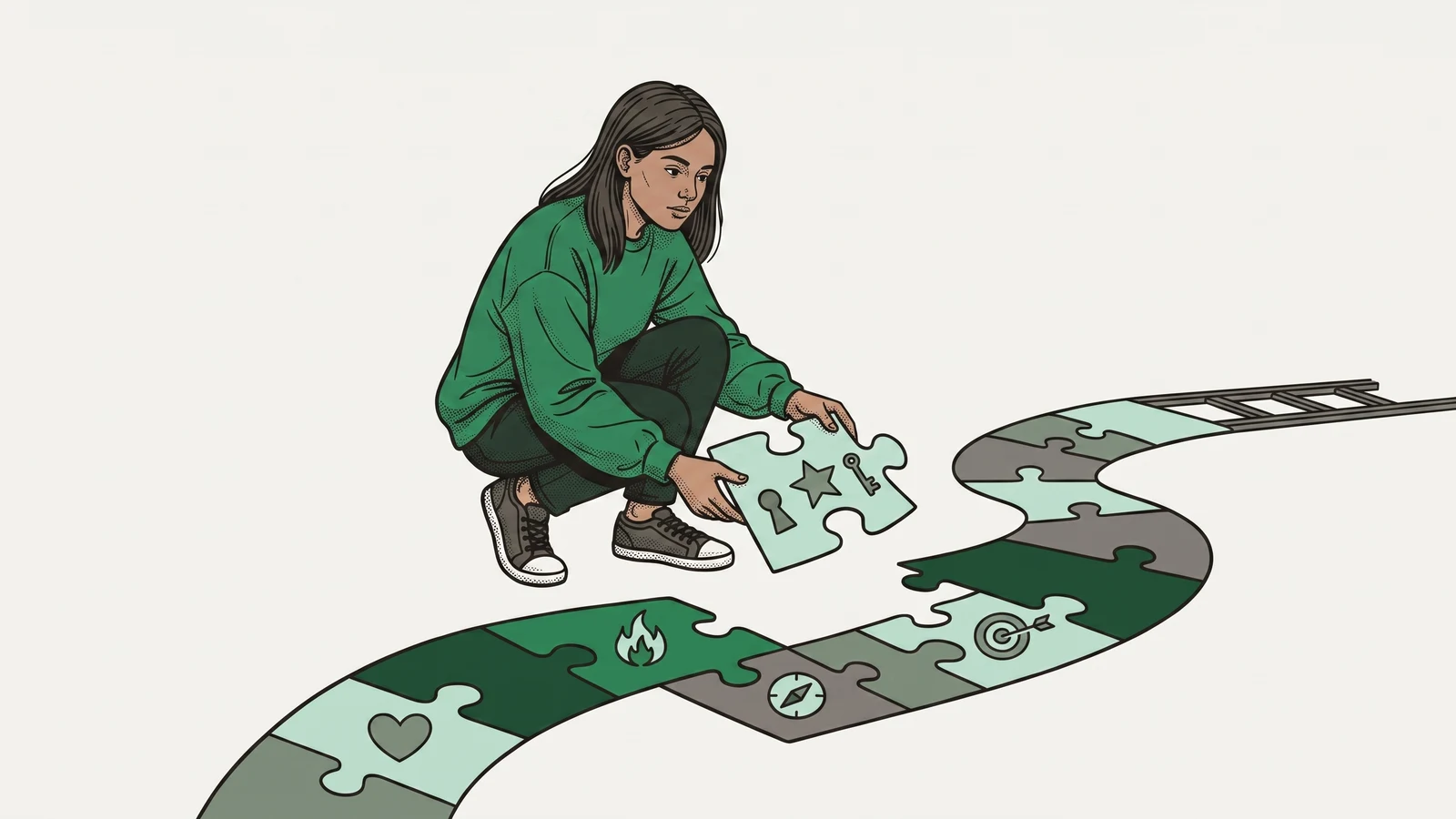
Most assessments end with a report. You read it, nod along, and file it away.
The Whole Human Assessment starts with a report, and then something actually happens next. Here's what that looks like.
Step One: The Assessment Itself
The Whole Human Assessment is a 124-item self-report that measures how often your teen engages in behaviors aligned with 31 developmental competencies, across six domains: Thought, Emotion, Social, Values, Mindset, and Identity.
It's not a diagnostic and not a grade. It's a strengths-based profile. Each competency is measured through specific observable behaviors, things like whether your teen pauses before reacting, how they respond when a plan falls apart, or whether they seek out new challenges. Four items per competency, with the scoring designed to surface where your teen is genuinely strong and where they have the most room to grow.
The result is not a single score. There's no pass or fail, no comparison to other learners. What your teen receives is their own profile, 31 competencies, sorted from their strongest to their most room to grow.
Step Two: The Whole Human Report
After completing the assessment, your teen receives the Whole Human Report, a structured profile across all 31 competencies that makes their results readable and meaningful, not just a list of numbers.
The Report shows:
- Which competencies are strongest for this learner right now
- Which have the most room to grow
- How the results connect to the six domains of development
This isn't a fixed verdict about who your teen is. It's a picture of where they are today, and the starting point for where they go next.
Step Three: Coach Match
Alongside the assessment, your teen completes the Precision Development quiz, a short set of questions about how they respond to challenge, what kind of feedback keeps them going, and how they prefer to learn.
From both inputs (the competency profile from the Whole Human Assessment and the learning style signals from the quiz) Altitude matches your teen with their Altitude Coach: a consistent guide-on-the-side present throughout every learning experience, in a voice calibrated to how your teen actually learns.
Two teens might have similar competency profiles and still receive very different coaching, because the voice that works for one may not work for the other. The match is to both: who they are and how they learn.
Step Four: The Personalized Development Path
With the Whole Human Report and Coach match in place, Altitude builds your teen's personalized development path, a sequenced set of Pathways drawn from their profile.
A Pathway is a full developmental cycle: a Course paired with a Challenge, plus the artifact the Course produces. Your teen doesn't just learn something, they apply it, practice it, and build evidence of their growth. That learn-then-apply loop is what makes competency development stick rather than sit.
The path prioritizes based on your teen's profile:
A teen whose profile shows Sustains Determination as a strength might begin with a Pathway that builds on that strength, using their determination as an on-ramp into a more challenging competency, like Thinks Critically or Resolves Conflicts.
A teen whose profile shows the most room to grow in Regulates Emotions might begin with a Pathway in the Emotion domain, starting where the development opportunity is clearest, in a sequence paced to build momentum rather than overwhelm.
No two teens start in the same place. No two paths look the same.
What Changes as Your Teen Grows
The Whole Human Assessment is a starting point, not a permanent label. As your teen works through Pathways (building competencies through courses, challenges, and reflection) their profile evolves. The platform tracks where they're growing and adjusts what comes next.
This is what "strengths-based" actually means in practice: not ignoring the areas with most room to grow, but building from what's already strong to create the momentum needed to develop what isn't yet.
Frequently asked questions
What happens after my teen takes the Whole Human Assessment?
Your teen receives the Whole Human Report, a structured profile of their strengths across all 31 competencies. From there, Altitude matches them with their Altitude Coach and builds a personalized development path: a sequenced set of Pathways drawn from their specific profile.
How does a strengths assessment create a personalized learning path?
The Whole Human Assessment produces a per-competency profile that shows where your teen is strongest and where they have the most room to grow. That profile, combined with the Precision Development quiz, tells Altitude which Pathways to prioritize and in what order, giving your teen a path that's specific to them, not a generic sequence everyone follows.
Is the Whole Human Assessment a diagnostic tool?
No. The Whole Human Assessment is a strengths-based self-report, not diagnostic, not clinical, and not a grade. It produces a personal competency profile for your teen, with no peer comparison and no single overall score. It's a starting point for development, not a verdict.
How often does the assessment need to be taken?
The Whole Human Assessment is taken at the start of your teen's Altitude journey to establish their profile and beginning path. As they work through Pathways and build competencies, their development is tracked throughout the experience.
How is this different from a personality test?
Personality tests assign types or categories. The Whole Human Assessment produces a developmental profile, 31 specific, buildable competencies that your teen can actually strengthen over time. The goal isn't a label. It's a starting point for intentional growth.
Related Resources
From Altitude:
The assessment isn't the destination. It's the map. What your teen does with it (the Pathways they work through, the competencies they build) is the journey.
Altitude opens to founding families in January 2027. Join the waitlist to be among the first families in Florida and Georgia.